- PV = planned, EV = done, AC = spent. Everything else is arithmetic on those three.
- CPI and SPI below 1.0 mean over budget and behind schedule.
- TCPI tells you whether the budget is still achievable.
- Take percent complete from the schedule or quantities — never from cost.
The three numbers
| PV · planned value | Budgeted cost of the work scheduled by today |
| EV · earned value | Budgeted cost of the work actually done = budget × % complete |
| AC · actual cost | What that work actually cost — from the ledger |
Measuring percent complete: the part that decides everything
Earned value is only as good as the percent complete behind it. Four common methods, from most to least objective:
| Method | How | Best for |
|---|---|---|
| Units installed | Installed quantity ÷ budgeted quantity | Repetitive work — conduit, drywall, pipe, concrete |
| Weighted milestones | Fixed credit per step (e.g. set 20%, connect 50%, test 30%) | Equipment and systems with clear steps |
| Fixed formula | 0/100 or 50/50 credit when an activity starts and finishes | Short activities, a week or two long |
| Cost-to-cost | Cost to date ÷ forecast total cost | Revenue recognition — not performance measurement |
Cost-to-cost is standard for revenue on the WIP schedule, but it cannot measure cost performance: it makes earned value equal actual cost. Use physical progress for EVM, by cost code or cost type.
Variances and indices
SV = EV − PV SPI = EV ÷ PV
EAC = BAC ÷ CPI ETC = EAC − AC
TCPI = (BAC − EV) ÷ (BAC − AC)
Below 1.0, CPI means over budget and SPI means behind schedule. TCPI is the efficiency the rest of the job must achieve to land on budget — if it is well above the CPI you are running, the budget is not realistic any more.
Note the sign convention: in PMI’s standard, VAC = BAC − EAC, so an overrun is negative. Many contractors (and this site) show overruns as positive; be consistent.
A worked example
This job is over budget (CPI 0.86) and slightly behind (SPI 0.94). To finish on budget the rest of the work would need a CPI of 1.08 — 25% better than it is running. That is not going to happen by itself.
For more inputs, a second forecast and a shareable link: the full cost overrun calculator →
Where EVM goes wrong on construction jobs
- Percent complete from cost makes EV equal AC and CPI always 1.0. Use schedule or quantities.
- One EV for the whole job hides which trade is the problem. Apply it by cost type or code.
- SPI late in the job drifts toward 1.0 whatever happens; use the schedule’s critical path for time.
- Ignoring committed cost understates AC.
The forecast view in the demo runs CPI-based EAC weekly with a range.
Earned value and the WIP schedule
Most contractors already produce one progress number a month: the percentage of completion on the WIP schedule, which is cost-to-cost. Put the physical percent complete next to it and the gap is itself an early warning. If a job is 40% complete by cost and 32% complete by installed quantities, it has spent eight points of budget it has not earned — the same signal as a CPI of 0.80, available the week the quantities are counted rather than when the budget runs out.
That comparison is what turns a WIP schedule from an accounting report into a forecast. The job cost forecasting guide shows how to carry it forward to a cost at completion.
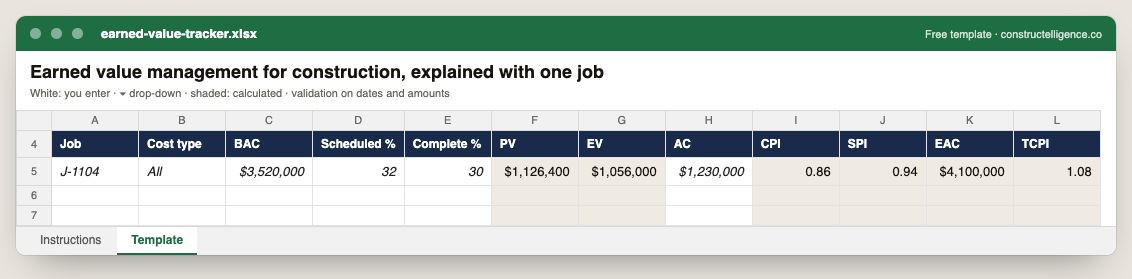
Budget at completion with scheduled and actual percent complete, and PV, EV, CPI, SPI, EAC and TCPI calculated from them and actual cost.
12 columns: 6 you fill in and 6 calculated by formula and filled down 200 rows, so nothing is worked out by hand. In the Excel version, 4 columns reject entries of the wrong type (a date column only takes dates, an amount column only numbers), the header row stays frozen with filters on it, and the workbook opens on an Instructions sheet that lists every column below.
Every column, and how it is captured
| Column | Type | What goes in it |
|---|---|---|
| Job | Text | Job number exactly as in your accounting system (e.g. J-1104), so rows join to job cost. |
| Cost type | Text | Labor, material, subcontract, equipment or other. |
| BAC | Amount ($) | Enter the amount in dollars. |
| Scheduled % | Percent | Enter a percentage, 0–100. |
| Complete % | Percent | Enter a percentage, 0–100. |
| PV | Calculated | Calculated: [BAC] × [Scheduled %] ÷ 100 |
| EV | Calculated | Calculated: [BAC] × [Complete %] ÷ 100 |
| AC | Amount ($) | Enter the amount in dollars. |
| CPI | Calculated | Calculated: [EV] ÷ [AC] |
| SPI | Calculated | Calculated: [EV] ÷ [PV] |
| EAC | Calculated | Calculated: [BAC] ÷ [CPI] |
| TCPI | Calculated | Calculated: ([BAC] − [EV]) ÷ ([BAC] − [AC]) |
See it on real-looking numbers
Constructelligence is a construction intelligence platform: it reads your ERP, project and field systems read-only and does this arithmetic every week, for every job. The demo runs it on a sample eight-job portfolio.
Try the demoJoin the private betaFrequently asked questions
What is earned value in construction?
Earned value is the budgeted cost of the work actually completed — the budget multiplied by percent complete. Comparing it with actual cost shows cost performance, and with planned value shows schedule performance.
What is the difference between CPI and SPI?
CPI (cost performance index) is earned value divided by actual cost; below 1.0 the job is over budget. SPI (schedule performance index) is earned value divided by planned value; below 1.0 the job is behind schedule.
What is TCPI?
The to-complete performance index is the cost efficiency the remaining work must achieve to finish on budget: (budget at completion − earned value) ÷ (budget at completion − actual cost). A TCPI far above the current CPI means the budget is no longer realistic.
Why shouldn't percent complete come from cost?
Because earned value then equals actual cost, so CPI is always 1.0 and an overrun stays hidden until the budget runs out. Measure percent complete from installed quantities, milestones or the schedule, and keep cost-to-cost for revenue recognition.
How do you calculate EAC with earned value?
The most common formula is budget at completion divided by CPI. Other variants include actual cost plus remaining work at budget rate, or dividing by CPI × SPI when schedule slip also drives cost.
Related guides
More in Forecasting & cost
- Committed cost in construction: track buyout and the exposure still to buy
- Construction cost codes: how to structure them and what they can tell you
Free tools for this topic: Construction cost overrun calculator · Construction labor burden calculator · Construction markup vs margin calculator
All forecasting & cost resources →