- EAC = cost to date + estimate to complete; the variance at completion is EAC − budget.
- The cost performance method (EAC = budget ÷ CPI) is the default; budget-remaining hides overruns.
- Percent complete must come from the schedule or installed quantities — never from cost.
- Forecast weekly, by cost type, with a range. Monthly forecasts find overruns weeks late.
What a job cost forecast is
Every job starts with a budget — the cost the estimate said it would take. As work happens, cost posts to the job ledger by cost code. The forecast combines what has been spent with what is left to do, and the gap between the forecast and the budget is the variance at completion (VAC):
VAC = EAC − budget
The hard part is the estimate to complete. The four common methods below differ only in how they guess it.
The four ways to forecast cost at completion
| Method | Estimate to complete | Use it when |
|---|---|---|
| Budget remaining | Budget − cost to date | Never on its own — it assumes every overrun so far stops today. |
| Cost performance (CPI) | (Budget − earned value) ÷ CPI | The default. Carries the job’s own efficiency forward. |
| CPI × SPI | (Budget − earned value) ÷ (CPI × SPI) | A job that is both over cost and behind schedule — lateness costs money too. |
| PM projected | The project manager’s bottom-up estimate | Late in a job, when the remaining work is specific and known. |
Earned value is the budgeted cost of the work actually done: budget × percent complete. CPI (cost performance index) is earned value ÷ actual cost — below 1.0 means each dollar spent is buying less than a dollar of planned work. With CPI, the forecast simplifies to:
A worked example
Job J-1104, a $4.0M apartment building with a $3.52M cost budget, twelve weeks in:
The budget-remaining method would have said this job finishes on budget — $1.23M spent plus $2.29M left. The CPI method says it finishes $580K over. The difference is the whole point of forecasting: the first number is what the spreadsheet shows, the second is what the job is doing.
For more inputs, a second forecast and a shareable link: the full cost overrun calculator →
Where job cost forecasts go wrong
- Percent complete taken from cost. If percent complete is cost to date ÷ budget, the job is always exactly on budget by definition. Percent complete has to come from somewhere else — the schedule, installed quantities, or the PM.
- Forecasting once a month. An overrun that starts in week five and is forecast at month-end is found in week nine or twelve. Cost posts weekly; the forecast should move with it.
- One number for the whole job. Labor, material, subcontract and equipment overrun for different reasons. Forecast each category — and ideally each cost code — on its own rate.
- Ignoring committed cost. A subcontract awarded but not yet invoiced is cost you have already agreed to. Leave it out and the forecast is low until the invoice lands.
- No range. A single EAC hides how sure you are. A range (for example, the 80% interval) tells an owner or a lender how much the number could still move.
Forecasting from your own past jobs
The CPI method assumes the job keeps performing exactly as it has. Real jobs don’t: crews speed up on repetitive floors, and some trades recover part of an early overrun. A model trained on your completed jobs learns how an early burn rate actually translated into final cost — by sector, trade and size — and forecasts from that instead of a straight line. In back-tests on past jobs this is usually markedly more accurate early in a job, which is exactly when the forecast is most useful.
The rules for trusting it are the same as for any forecast: it must show its working, give a range, and be checkable against the ledger. The demo’s labor forecast shows each of those on sample data. For where forecasting sits alongside takeoff, scheduling and document AI, see AI in construction.
Getting started
Start with CPI-based forecasts by cost category, updated weekly from the job cost ledger, with percent complete taken from the schedule. That alone finds most overruns weeks earlier than a month-end pack. The free forecast-at-completion calculator runs the arithmetic above on your own numbers.
Forecast each cost type its own way
One CPI for the whole job blends problems that have different causes and different fixes. Forecast each cost type on the evidence that type actually has:
| Cost type | Best evidence | Estimate to complete from |
|---|---|---|
| Subcontract | Signed subcontracts and change orders | Remaining committed + pending changes + scopes still to buy |
| Material | Issued POs and installed quantities | Open POs + remaining quantity × current price |
| Labor | Hours and installed quantities | Remaining quantity × actual hours per unit × rate |
| Equipment | Time on site | Remaining duration × rental or internal rate |
| General conditions | The schedule | Remaining months × monthly GC cost |
Subcontract and material are mostly known once bought — see committed cost. Labor is where forecasts most often go wrong, which is why it gets its own method in labor forecasting.
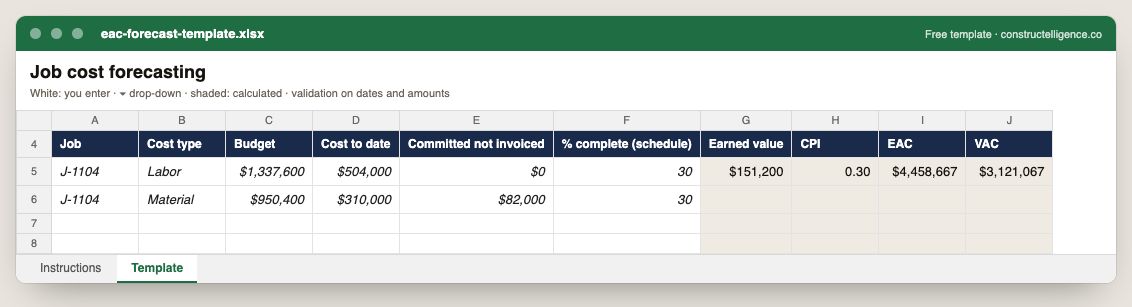
Budget, cost to date and committed cost by job and cost type, with earned value, CPI, estimate at completion and variance at completion calculated.
10 columns: 6 you fill in and 4 calculated by formula and filled down 200 rows, so nothing is worked out by hand. In the Excel version, 4 columns reject entries of the wrong type (a date column only takes dates, an amount column only numbers), the header row stays frozen with filters on it, and the workbook opens on an Instructions sheet that lists every column below.
Every column, and how it is captured
| Column | Type | What goes in it |
|---|---|---|
| Job | Text | Job number exactly as in your accounting system (e.g. J-1104), so rows join to job cost. |
| Cost type | Text | Labor, material, subcontract, equipment or other. |
| Budget | Amount ($) | The budget for the line, from the estimate plus approved changes. |
| Cost to date | Amount ($) | Enter the amount in dollars. |
| Committed not invoiced | Amount ($) | Enter the amount in dollars. |
| % complete (schedule) | Percent | Enter a percentage, 0–100. |
| Earned value | Calculated | Calculated: [Cost to date] × [% complete (schedule)] ÷ 100 |
| CPI | Calculated | Calculated: [Earned value] ÷ [Cost to date] |
| EAC | Calculated | Calculated: [Budget] ÷ [CPI] |
| VAC | Calculated | Calculated: [EAC] − [Budget] |
See it on real-looking numbers
Constructelligence is a construction intelligence platform: it reads your ERP, project and field systems read-only and does this arithmetic every week, for every job. The demo runs it on a sample eight-job portfolio.
Try the demoJoin the private betaFrequently asked questions
What is EAC in construction?
EAC — estimate at completion — is the forecast of what a job will have cost when it is finished: cost to date plus the estimate to complete. Comparing it with the budget gives the variance at completion, which is how you know a job is going over.
How do you calculate cost at completion?
The most common method is budget divided by the cost performance index (CPI), where CPI is earned value divided by actual cost. For a $3.52M budget at a CPI of 0.86, the forecast is about $4.10M. Other methods use budget remaining, CPI times SPI, or the project manager's bottom-up estimate.
How often should job cost forecasts be updated?
Weekly, or whenever cost posts. A monthly forecast finds an overrun that started early in the month three to seven weeks late, by which point the options for recovering it are fewer and more expensive.
Why can't percent complete come from cost?
Because it makes the forecast circular: if percent complete is cost to date divided by budget, earned value always equals cost and the job always looks on budget. Percent complete should come from the schedule, installed quantities or the project manager.
What is the difference between EAC and ETC?
ETC (estimate to complete) is the cost still to come from today. EAC (estimate at completion) is the total: cost to date plus ETC. Comparing EAC with the budget gives the variance at completion.
Should you forecast a job as one number or by cost type?
By cost type. Subcontract and material costs are largely fixed once bought, while labor and equipment move with productivity and time — one blended rate hides which one is going wrong.
Related guides
More in Forecasting & cost
- Committed cost in construction: track buyout and the exposure still to buy
- Earned value management for construction, explained with one job
Free tools for this topic: Construction cost overrun calculator · Construction labor burden calculator · Construction markup vs margin calculator
All forecasting & cost resources →