- Conditional = effective when paid; unconditional = effective when signed.
- Progress waivers cover payment through a date; final waivers cover the whole job.
- Put the payment amount on the waiver, and list retainage, pending COs and claims as exceptions.
- Never sign an unconditional waiver for money that has not cleared.
The four types
Two questions decide which waiver you are signing: does it take effect only when payment arrives (conditional) or the moment it is signed (unconditional)? And does it cover payment through a date (progress, or partial) or the whole job (final)?
| Progress (through a date) | Final (the whole job) | |
|---|---|---|
| Conditional effective once paid | Sent with each pay application. Waives rights for the amount stated, only if that payment is received. | Sent with the final pay application. Waives all remaining rights, only once final payment is received. |
| Unconditional effective on signing | Given after a progress payment has cleared, confirming receipt. | Given after final payment has cleared. Nothing is left to claim. |
The rule that follows from the table: never sign an unconditional waiver for money that has not cleared your bank. An unconditional waiver is effective even if the check bounces or never comes.
How waivers move with a pay application
- The subcontractor submits its pay application to the general contractor with a conditional progress waiver for the amount requested.
- The GC rolls the subs' applications into its own and sends the owner its pay application with its own conditional progress waiver and, commonly, the subs' conditional waivers.
- The owner or lender pays the GC. The GC pays the subs.
- Each party that has been paid gives an unconditional progress waiver for the previous payment — so the owner collects this month's conditional waivers and last month's unconditional ones together.
- At the end of the job the same cycle runs once more with final waivers, usually alongside retainage release.
Tiers matter: a supplier to a subcontractor can often have lien rights too, which is why owners and lenders ask for waivers from lower tiers on larger jobs.
What amount goes on the waiver
A progress waiver should state the payment amount and a through date, not the contract value or the gross amount billed. For Riverside's sixth application:
The $115,000 of retainage is not being paid this month, so it should not be waived. The same goes for pending change orders, disputed extras and any claim you are still pursuing. List them as exceptions on the waiver. A waiver with no exceptions can be read as giving up rights to work that has not been paid for.
The G702 figures come from the pay application guide, and the retainage from the retainage guide. The pay application calculator works out the payment amount on your own figures.
Statutory forms and state rules
Some states publish statutory waiver forms that have to be used word for word — among them California, Texas, Arizona, Georgia, Nevada and Utah — and in those states a waiver that departs from the form may not be enforceable. Other states have no required form but have their own rules on when a waiver is effective and whether it can be required before payment. Before you standardise one waiver form across jobs in several states, check each state's statute or ask construction counsel. This guide describes common practice, not the law of any one state.
Tracking waivers without chasing them
The usual failure is not signing the wrong waiver — it is missing one. An owner holds a payment because one sub's unconditional waiver from last month never arrived. A waiver log fixes that:
- One row per party per pay application: party, tier, application number, through date, amount, type, date received.
- Pair each conditional waiver with its unconditional follow-up, and flag any payment made more than a couple of weeks ago with no unconditional waiver on file.
- Check the amount on each waiver against the commitment and what was actually paid. A mismatch is either a billing error or a payment that went astray.
- Keep the exceptions column. At closeout it is the list of what is still owed.
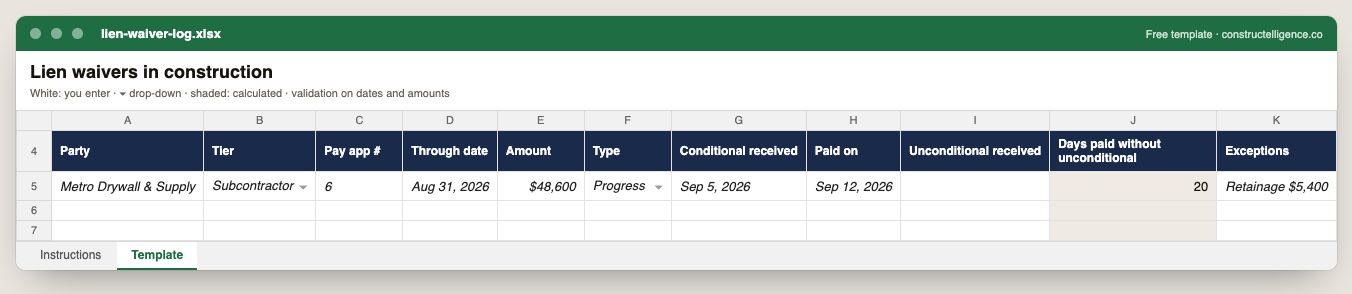
Every waiver per party and pay application: tier, through date, amount, type, when the conditional arrived, when payment was made and when the unconditional arrived — with days paid without an unconditional flagged — and exceptions.
11 columns: 8 you fill in, 2 picked from drop-down lists, so every row uses the same values and 1 calculated by formula and filled down 200 rows, so nothing is worked out by hand. In the Excel version, 5 columns reject entries of the wrong type (a date column only takes dates, an amount column only numbers), the header row stays frozen with filters on it, and the workbook opens on an Instructions sheet that lists every column below.
Every column, and how it is captured
| Column | Type | What goes in it |
|---|---|---|
| Party | Text | Free text. |
| Tier | Drop-down | Options: Subcontractor / Supplier / Sub-tier. |
| Pay app # | Text | Free text. |
| Through date | Date | Enter the date. |
| Amount | Amount ($) | Enter the amount in dollars. |
| Type | Drop-down | Options: Progress / Final. |
| Conditional received | Date | Enter the date. |
| Paid on | Date | Enter the date. |
| Unconditional received | Date | Enter the date. |
| Days paid without unconditional | Calculated | Calculated — days since payment with no unconditional waiver on file — chase anything over 14 (= IF(AND([Paid on] ≠ blank, [Unconditional received]=blank), TODAY() − [Paid on], blank)) |
| Exceptions | Text | Free text. |
See it on real-looking numbers
Constructelligence is a construction intelligence platform: it reads your ERP, project and field systems read-only and does this arithmetic every week, for every job. The demo runs it on a sample eight-job portfolio.
Try the demoJoin the private betaFrequently asked questions
What is a lien waiver in construction?
A signed document in which a contractor, subcontractor or supplier gives up some or all of its mechanic's lien rights on a project, usually in exchange for a payment. Owners and lenders collect them with pay applications to show that payments have reached the people who did the work.
What is the difference between a conditional and an unconditional lien waiver?
A conditional waiver takes effect only once the stated payment is actually received. An unconditional waiver takes effect when it is signed, whether or not payment arrives, so it should only be signed after the money has cleared.
What is the difference between a progress and a final lien waiver?
A progress (partial) waiver covers payment through a stated date and leaves rights to later work intact. A final waiver covers the whole job and is given with, or after, final payment.
Should retainage be included on a lien waiver?
Not on a progress waiver. Retainage has not been paid, so it is normally listed as an exception, along with pending change orders and disputed amounts, until it is released and paid.
Are lien waiver forms the same in every state?
No. Several states, including California, Texas, Arizona, Georgia, Nevada and Utah, require statutory forms, and the rules on when a waiver takes effect differ between states. Check the rules where the project is, or ask construction counsel.
Related guides
More in Billing & cash
- The WIP schedule: over-billing, under-billing and why they matter
- Construction invoice template: what to put on it, a filled-in example, and a free download
- Construction cash flow forecasting: a 13-week model that works
Free tools for this topic: Over/under billing calculator (WIP) · Pay application and retainage calculator · G703 continuation sheet PDF to Excel
All billing & cash resources →