- AI is moving from assistants to agents that do tasks — pilot one workflow with human approval.
- Platforms are becoming connected data environments; clean keys make them work.
- Use reality capture for measured percent complete, not just photos.
- Don't migrate systems for the trend — get the answers from what you run.
1. AI moves from chat to agents
The big platforms have shifted from AI assistants that answer questions to agents that do tasks: Procore’s Agent Builder, Trunk Tools’ document agents, Autodesk’s project-data agent. Expect agents that check submittals, draft RFIs and chase paperwork. What to do: pick one repetitive workflow and pilot an agent on it, with a person approving every output. See AI in construction.
2. Platforms become connected data environments
Autodesk folded Autodesk Construction Cloud into Autodesk Forma in March 2026 and renamed Docs to Forma Data Management — a signal that vendors are selling a data environment, not a set of apps. What to do: make sure your job numbers, cost codes and vendors are consistent, because every connected-data promise depends on them. See the tech stack guide.
3. Reality capture becomes routine
360° walks, lidar and drones have gone from pilots to weekly routine on large projects, and vendors are adding progress measurement against the model and schedule. What to do: use measured progress for percent complete, not just for photos. See AI safety and progress tracking.
4. Construction intelligence becomes a category
“Construction intelligence” is now used by several vendors for the layer that reads across a contractor’s systems and answers what is going on — progress, cost, risk. What to do: ask of any such product which systems it reads, whether it is read-only, and whether every number traces to source rows. Constructelligence does this for cost, forecasting and cash.
5. Prefabrication and off-site keep growing
More MEP racks, bathroom pods, wall panels and modular units are built off site, moving work from the field into a factory schedule. What to do: track prefabricated assemblies as their own cost codes so the savings (or not) show up in job cost.
6. Task robots find their niches
Robots that print layout, drill ceilings or finish drywall are in real use on large commercial jobs; general-purpose site robots are not. What to do: evaluate by task and repetition — robots pay back on floors that repeat.
7. Sensors and connected equipment
Telematics on equipment, concrete maturity sensors and environmental monitoring feed data that used to be written on a clipboard. What to do: start with equipment hours tied to jobs — it is the sensor data that most directly becomes cost.
8. ERPs move to the cloud — slowly
Cloud construction ERPs keep gaining ground, but many mid-sized contractors still run on-premise systems that work. What to do: do not migrate for its own sake; get the reporting and forecasting you need from the system you have, and move when there is a business reason. See construction accounting software.
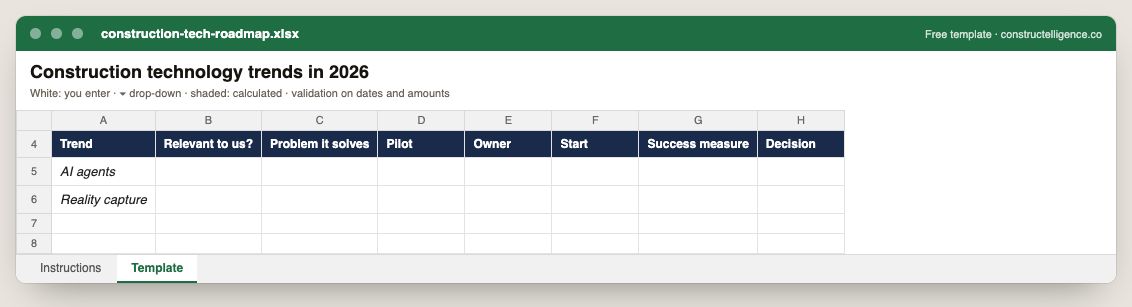
Each technology trend with whether it is relevant, the problem it solves, the pilot, owner, start date, success measure and decision.
8 columns: 7 you fill in and 1 picked from drop-down lists, so every row uses the same values. In the Excel version, 1 column reject entries of the wrong type (a date column only takes dates, an amount column only numbers), the header row stays frozen with filters on it, and the workbook opens on an Instructions sheet that lists every column below.
Every column, and how it is captured
| Column | Type | What goes in it |
|---|---|---|
| Trend | Text | Free text. |
| Relevant to us? | Drop-down | Options: Yes / No. |
| Problem it solves | Text | Free text. |
| Pilot | Text | Free text. |
| Owner | Text | The person responsible for the row. |
| Start | Date | Enter the date. |
| Success measure | Text | Free text. |
| Decision | Text | Free text. |
See it on real-looking numbers
Constructelligence is a construction intelligence platform: it reads your ERP, project and field systems read-only and does this arithmetic every week, for every job. The demo runs it on a sample eight-job portfolio.
Try the demoJoin the private betaFrequently asked questions
What are the biggest construction technology trends in 2026?
AI agents that do tasks rather than just answer questions, construction platforms becoming connected data environments, routine reality capture with progress measurement, the rise of construction intelligence platforms, more prefabrication, task-specific robots, connected equipment and sensors, and a gradual move of construction ERPs to the cloud.
How is AI changing construction in 2026?
AI is moving from chat assistants to agents that check submittals, draft RFIs and review documents, while computer vision is used for takeoff, progress tracking and safety, and forecasting tools predict cost and schedule outcomes from project data.
What construction technology should a contractor invest in first?
Clean, connected data: consistent job numbers, cost codes and vendors across the ERP and project management platform. Every other technology — AI, dashboards, reality capture — depends on it.
Is construction technology adoption increasing?
Yes, especially in project management platforms, reality capture and AI features inside tools contractors already use. Adoption is fastest where the technology fits an existing weekly routine.
Related guides
More in Construction software & tech
- The best construction management software in 2026: 12 platforms compared, and how to choose
- Construction accounting software and ERP: the main systems and how to choose
- Construction estimating software: takeoff and bid tools compared
- Construction scheduling software: Primavera P6, Microsoft Project and the rest
- Construction dashboards and BI: Power BI, Excel or construction intelligence?
- Sage 300 CRE reporting: job cost, WIP and dashboards without rebuilding Excel
- QuickBooks job costing for contractors: setup, reports and when you outgrow it
Free tools for this topic: Construction PDF to Excel converter · Schedule PDF to Excel (P6 & MS Project) · Construction schedule health check
All construction software & tech resources →