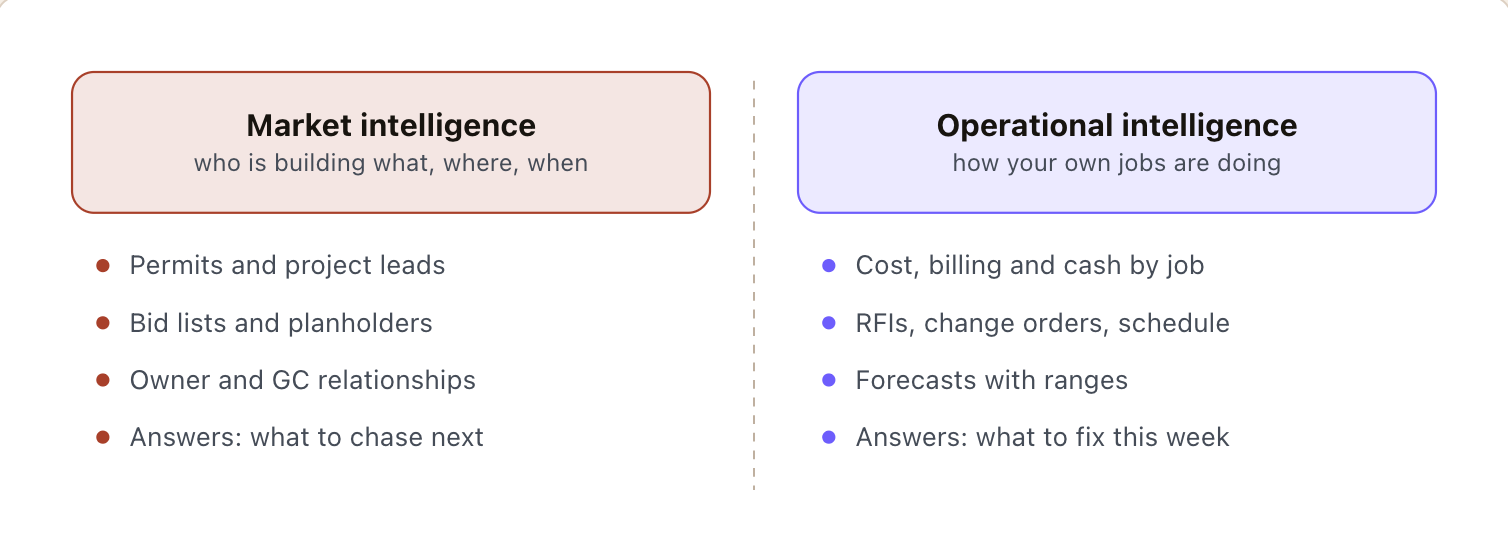
- “Construction intelligence” means market/lead intelligence to business development and own-data intelligence to operations and finance.
- Operational construction intelligence reads ERP, PM, payroll and schedule data and forecasts each job while it runs.
- It differs from BI because the construction data model and arithmetic are built in, and from ERP reports because it looks forward.
- Consistent job numbers and cost codes matter more than any feature.
- Evaluate on your own systems: tie out closed jobs, back-test the forecast, confirm it never writes back.
The two meanings of construction intelligence
Both are “intelligence” because they turn scattered information into a decision. They answer different questions, from different data, for different people.
| Market & project-lead intelligence | Operational construction intelligence | |
|---|---|---|
| Question it answers | What work is coming, and who is chasing it? | How are our jobs actually doing, and what happens next? |
| Data | Planning applications, permits, bid notices, public tenders, contract awards | Your job cost, commitments, billing, payroll, schedule and change orders |
| Used by | Business development, estimating, suppliers, manufacturers | Owners, CFOs, operations leads, project managers |
| Output | Project leads, bidder lists, market forecasts | Cost-at-completion forecasts, WIP, cash forecasts, early warnings |
| Examples | Dodge Construction Network, ConstructConnect, BuildCentral, public permit portals | Construction intelligence platforms that read your ERP and PM systems, such as Constructelligence |
The rest of this guide says which is which. If you came here for project leads, the next section is yours; if you came to understand your own portfolio, skip to operational intelligence.
Market and project-lead intelligence
Lead-intelligence services collect early signals that a project exists — planning filings, permits, design-team announcements, bid invitations and awards — and turn them into searchable project records with stages, values, bidder lists and contacts. A contractor uses them to find work earlier than a public bid notice; a supplier uses them to know which contractors to call.
- Dodge Construction Network — long-running project and bid data for North American commercial construction, with market forecasting.
- ConstructConnect — project leads and bid-document access, used by general contractors, trades and building-product manufacturers.
- BuildCentral — project and facility leads, including permit-based and planning-stage data.
- Public sources — city permit portals and open-data feeds (for example New York City’s DOB records), federal award data on USAspending.gov, and state and agency procurement sites. Free, but you do the joining yourself.
What to check before you subscribe: coverage in your region and sector, how early in the project life a record appears, how often bidder lists are updated, and whether you can export leads into your CRM rather than re-keying them.
Operational construction intelligence: insight from your own jobs
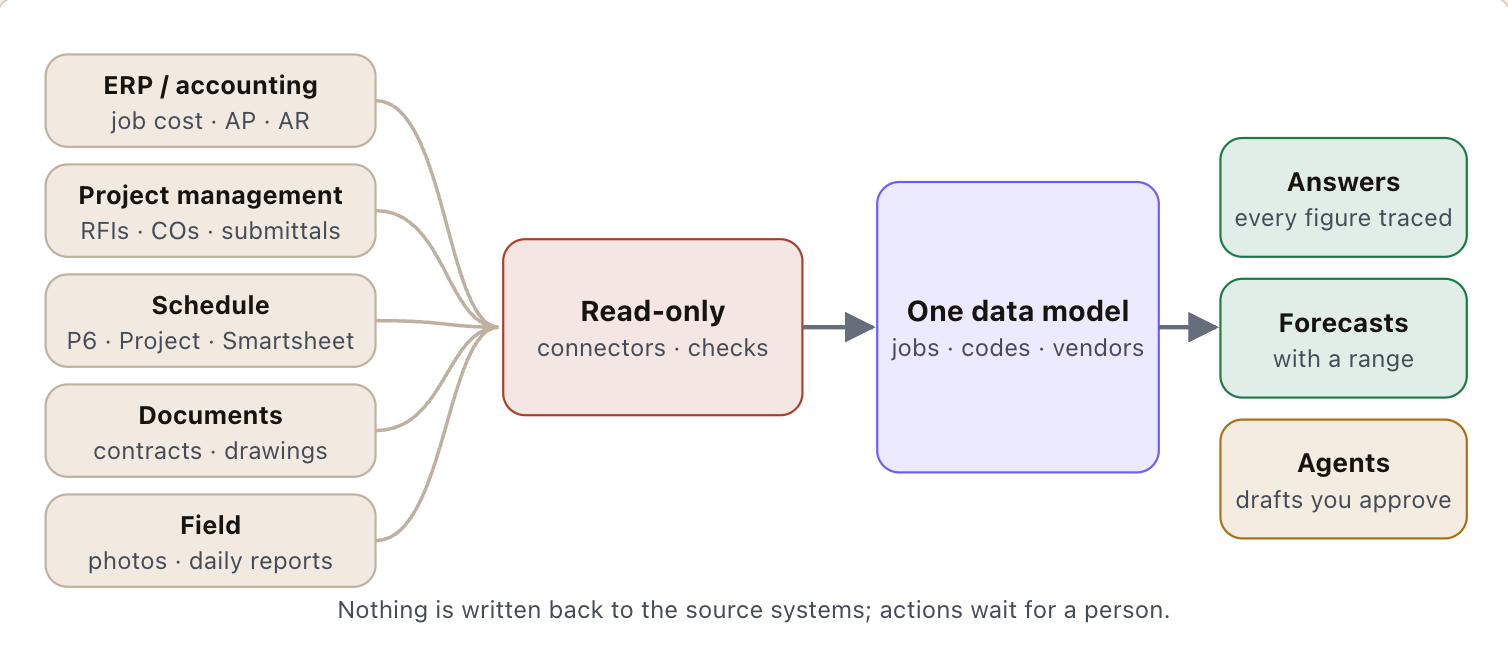
The second meaning is newer and closer to what the word means in other industries. A contractor already holds the answers to its hardest questions — they are spread across the accounting system, the project management platform, payroll, the schedule and the field apps, in different formats and keyed differently. Operational construction intelligence reads those systems, joins them on job number and cost code, and works out what is happening:
- Cost at completion, while the job runs. Cost to date plus committed cost plus the remaining work, compared with the estimate — so a fade shows up in week 8, not at closeout. See job cost forecasting.
- Over/under billing and WIP calculated every week instead of at month end — see the WIP schedule guide.
- Change exposure: change events priced but not approved, approved but not billed, or work done with no change order at all.
- Cash: when billings, retainage and payables put the company at its low point.
- Labour: hours burned against hours earned by cost code, from payroll and quantities.
- Documents matched to the ledger: invoices, subcontracts and change orders checked against what was posted.
The difference from a report is that it is forward-looking and continuous: it says which jobs will finish badly and why, every week, without someone assembling a spreadsheet first.
Constructelligence is a construction intelligence platform of this operational kind: it reads the accounting, project, payroll and schedule systems a contractor already runs, read-only, and forecasts every job weekly by cost code.
Other ways the term is used
Around the two main meanings, vendors and buyers use “construction intelligence” with a qualifier in front. Each names a narrower job, with its own data:
| Term | What it usually means | Data it runs on |
|---|---|---|
| Early project intelligence | Projects found at planning or design stage, before they go to bid | Planning applications, zoning and permit filings, design-team announcements |
| Competitive intelligence | Who bid, who won and at what price — your hit rate against named competitors | Bid results, public award data, your own bid history |
| Construction business intelligence (BI) | Dashboards and reports over company data | Whatever is loaded into the BI tool — see dashboards & BI |
| Field or reality intelligence | What is physically built on site, compared with the model and the schedule | 360° photo and video walks, laser scans, drone surveys, BIM — see AI progress tracking |
| Workforce intelligence | Who is on site, hours, productivity and certifications | Time and attendance, badging, payroll, training records |
| Cost data intelligence | Benchmark unit costs and escalation for estimating | Published cost databases (RSMeans data is the best-known), your own estimate-vs-actual history |
| Operational intelligence | Which of your jobs will finish over budget, and why — the second meaning above | Your ERP, project management, payroll and schedule, joined |
They are not rival definitions; a contractor can use several. The test of any of them is the same: does it change a decision this week — which job to chase, which crew to move, which forecast to correct?
Construction intelligence vs BI, ERP reports and PM platforms
| Tool | What it is good at | Where it stops |
|---|---|---|
| ERP reports (Sage, Viewpoint, Foundation…) | Accurate, auditable history of cost and billing | Backward-looking; only sees accounting data; forecasts are typed in by PMs |
| Project management platform (Procore, Autodesk Forma…) | RFIs, submittals, change events, daily logs | Sees the project, not payroll, overhead or the whole company’s cash |
| BI dashboards (Power BI, Excel) | Flexible charts over any data you load | Someone has to build and maintain the joins, the cost-code mapping and every formula — see dashboards & BI |
| Construction intelligence platform | Joins ERP, PM, payroll and schedule; forecasts; flags exceptions; answers questions | Only as good as the job numbers and cost codes it reads; it should not replace the system of record |
A useful rule: the ERP stays the book of record, the PM platform runs the work, and the intelligence layer reads both without writing back. A read-only design is what lets a finance team trust it on day one — see read-only by design.
The data construction intelligence needs
Most of it already exists. What decides whether the output is right is whether the pieces share keys.
| Source | What it supplies | What usually goes wrong |
|---|---|---|
| Accounting / ERP | Budget, cost to date, committed cost, billings, retainage, AP, AR | Revised budgets not posted; commitments entered late |
| Project management | Change events, RFIs, submittals, owner approvals | Change events never priced, or priced in a different cost code |
| Payroll & time | Hours and labour cost by job and cost code | Time coded to a catch-all code |
| Schedule | Planned and actual dates, percent complete | Percent complete updated monthly, or never |
| Estimate | The original plan to compare against | Estimate structure differs from the cost-code structure |
One job-number format and one cost code structure across systems is worth more than any feature. The tech stack guide shows which system should own which field.
Where construction AI fits
Construction intelligence and construction AI overlap but are not the same. The forecasting can be plain arithmetic and statistics; AI earns its place in three narrower jobs:
- Predictive models that learn which jobs fade from your own history and from public contract data, and flag them earlier than a straight-line forecast.
- Language models that answer a question in plain English (“which jobs are under-billed by more than $50k?”) by querying the data — with every number checked against the source rather than generated.
- Document reading that matches invoices, subcontracts and change orders to the ledger.
The test for any of it: can it show the rows behind the answer? An assistant that cannot cite the job, cost code and amount is not intelligence, it is a guess with good grammar. And no AI tool should be able to approve, pay or post anything on its own — the AI buyer’s guide lists the questions to ask.
How to evaluate a construction intelligence platform
- Connect it to your real systems in the trial, not a sample company. Which ERP and PM versions does it read today, and how — API, database or export?
- Tie it out. Pick three closed jobs; its cost, billing and margin should match your final job cost reports to the dollar.
- Back-test the forecast. On a finished job that went over, in which week would it have raised the flag? Earlier than your PM did?
- Check it never writes back. Read-only credentials, and no path from the assistant to payments or postings.
- Ask what happens when codes do not match. A good platform shows unmapped cost codes and orphaned commitments instead of silently dropping them.
- Price it on the company, not the seat, if owners, PMs and superintendents all need to see it.
- Ask where the data lives — cloud region, self-hosting option, retention, subprocessors.
A 30-day start
- Week 1: list every system and the job-number format each uses; pick five active jobs, one known to be in trouble.
- Week 2: connect read-only and tie the five jobs out to the ERP.
- Week 3: compare the platform’s cost-at-completion with each PM’s forecast; investigate every gap over 2% of contract.
- Week 4: run the weekly review from the platform instead of the spreadsheet; keep the spreadsheet for one more month as a check.
If the forecasts disagree with your PMs, that is the point: one of them knows something the other does not, and the conversation is worth having in week 4 rather than at closeout.
8 columns: 6 you fill in and 2 picked from drop-down lists, so every row uses the same values. In the Excel version, the header row stays frozen with filters on it, and the workbook opens on an Instructions sheet that lists every column below.
Every column, and how it is captured
| Column | Type | What goes in it |
|---|---|---|
| System | Text | Free text. |
| Data it holds | Text | Free text. |
| Job number format | Text | Free text. |
| Cost codes match ERP? | Drop-down | Options: Yes / No. |
| Update frequency | Text | Free text. |
| Connection (API / database / export) | Drop-down | Options: API / database / export. |
| Owner | Text | The person responsible for the row. |
| Gaps found | Text | Free text. |
See it on real-looking numbers
Constructelligence is a construction intelligence platform: it reads your ERP, project and field systems read-only and does this arithmetic every week, for every job. The demo runs it on a sample eight-job portfolio.
Try the demoJoin the private betaFrequently asked questions
What is construction intelligence?
Construction intelligence means turning construction data into decisions. It is used in two ways: market intelligence — project leads, bidder lists and awards from services such as Dodge Construction Network and ConstructConnect — and operational intelligence, which reads a contractor’s own ERP, project management, payroll and schedule data to forecast cost at completion, WIP, cash and change exposure while jobs are still running.
What is a construction intelligence platform?
Software that connects to the systems a contractor already uses — accounting/ERP, project management, payroll and scheduling — joins them on job number and cost code, and produces forecasts, exception alerts and answers to questions. Unlike a dashboard tool, the joins and the construction arithmetic are built in; unlike an ERP, it looks forward rather than back.
How is construction intelligence different from business intelligence?
Business intelligence tools such as Power BI are general-purpose: you supply the data model, the joins and every formula. Construction intelligence platforms ship with the construction model — job, cost code, cost type, commitment, change order, schedule of values — so cost at completion, over/under billing and change exposure work without building them.
Is construction intelligence the same as construction AI?
No. Much of construction intelligence is arithmetic and statistics on clean, joined data. Construction AI is used inside it for predicting which jobs will fade, answering questions in plain language, and reading documents — but the numbers should always trace back to rows in the source systems.
What data do you need for construction intelligence?
Job cost and committed cost from the ERP, change events from the project management platform, hours from payroll, and planned and actual dates from the schedule — joined by a consistent job number and cost code. Most contractors already have all of it.
What is field or reality intelligence in construction?
Software that captures what has actually been built — from 360° photos, laser scans or drone surveys — and compares it with the design model and the schedule, so progress and deviations are measured rather than reported. It is one input to operational construction intelligence, which joins that progress to cost, billing and labour.
What is early construction project intelligence?
Information about projects at planning or design stage, before they are advertised for bid — planning and permit filings, zoning decisions and design-team appointments. Market-intelligence services collect it so contractors and suppliers can build relationships before the bid list is set.
Who provides construction market intelligence?
Commonly used providers in North America include Dodge Construction Network, ConstructConnect and BuildCentral. Public permit portals, open-data feeds and federal award data on USAspending.gov are free alternatives that take more work to join.
Related guides
More in Construction software & tech
- The best construction management software in 2026: 12 platforms compared, and how to choose
- Construction accounting software and ERP: the main systems and how to choose
- Construction estimating software: takeoff and bid tools compared
- Construction takeoff software: the tools, by trade, and how to test one
- Construction scheduling software: Primavera P6, Microsoft Project and the rest
- Construction dashboards and BI: Power BI, Excel or construction intelligence?
- Construction technology trends in 2026: what is actually changing
- Sage 300 CRE reporting: job cost, WIP and dashboards without rebuilding Excel
- QuickBooks job costing for contractors: setup, reports and when you outgrow it
Free tools for this topic: Construction PDF to Excel converter · Schedule PDF to Excel (P6 & MS Project) · Construction schedule health check
All construction software & tech resources →