- Base bid items add up to the number on the bid letter.
- Alternates, allowances and unit prices on their own rows.
- Exclusions against the item they qualify.
- Price from the estimate and your overhead, not from the market alone.
What a construction bid has to state
- Base bid — the price for the scope as drawn and specified, broken into the items the bid form asks for.
- Alternates — priced options the owner may accept: add alternates raise the price, deduct alternates lower it.
- Allowances — amounts the owner told every bidder to carry, so bids stay comparable.
- Unit prices — rates for work whose quantity is uncertain (rock excavation, extra outlets).
- Exclusions and clarifications — what the price does not include or assumes. See the scope of work template.
A filled-in example
Metro Interiors' drywall bid for Maple Street Medical Office:
| Item | Description | Type | Qty | Unit price | Total |
|---|---|---|---|---|---|
| 1 | Partitions incl. framing, Level 4 | Base bid | 14,200 SF | $4.10 | $58,220 |
| 2 | Level 5 at lobby feature wall | Base bid | 820 SF | $6.25 | $5,125 |
| 3 | Blocking allowance | Allowance | 1 LS | $6,500 | $6,500 |
| 4 | Framing above 10 ft, floor 2 corridor | Add alternate | 2,600 SF | $3.40 | $8,840 |
| 5 | Additional board, per SF | Unit price | 1 SF | $3.95 | — |
The base bid is items 1–3: $69,845. The alternate and unit price are priced but not in that number — a bid that rolls them in can't be compared with the others and usually gets a call, or gets dropped.
Pricing the bid
Start from the estimate, not from what you think the job will go for. Then check the result against your own break-even: the overhead recovery calculator shows the margin a bid has to carry to cover the office.
How to fill it in
- Enter base bid items first, matching the owner's bid form or the scope of work item numbers.
- Add alternates, allowances and unit prices on their own rows with the right Bid type.
- Filter Bid type = Base bid to check the total equals the price on your bid letter.
- Write exclusions and clarifications against the item they qualify, not only at the bottom.
- Export to PDF with your cover letter.
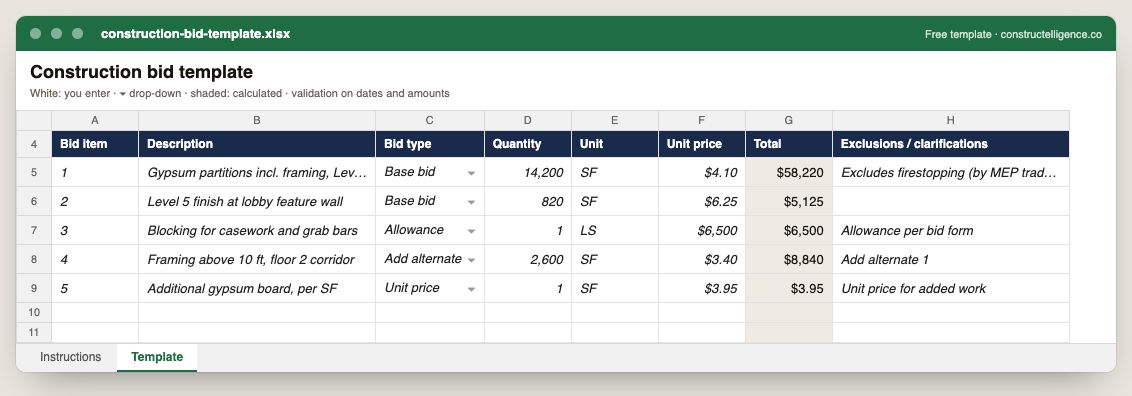
Everything a bid has to state so it can be compared and accepted without a phone call: each bid item, whether it is base bid, an alternate, an allowance or a unit price, quantity, unit price and total — and the exclusions and clarifications that qualify it.
8 columns: 6 you fill in, 1 picked from drop-down lists, so every row uses the same values and 1 calculated by formula and filled down 200 rows, so nothing is worked out by hand. In the Excel version, 2 columns reject entries of the wrong type (a date column only takes dates, an amount column only numbers), the header row stays frozen with filters on it, and the workbook opens on an Instructions sheet that lists every column below.
Every column, and how it is captured
| Column | Type | What goes in it |
|---|---|---|
| Bid item | Text | Item number matching the bid form or the scope of work. |
| Description | Text | What the line is, in words the other party will recognise. |
| Bid type | Drop-down | Base bid items add up to the bid; alternates, allowances and unit prices are priced separately. Options: Base bid / Add alternate / Deduct alternate / Allowance / Unit price. |
| Quantity | Number | Enter a number. |
| Unit | Text | Unit of measure (EA, LF, SF, CY, HR, LS). |
| Unit price | Amount ($) | Price per unit; for lump-sum items use quantity 1 and unit LS. |
| Total | Calculated | Calculated: [Quantity] × [Unit price] |
| Exclusions / clarifications | Text | What the price does not include, or assumes — the line that prevents disputes later. |
See it on real-looking numbers
Constructelligence is a construction intelligence platform: it reads your ERP, project and field systems read-only and does this arithmetic every week, for every job. The demo runs it on a sample eight-job portfolio.
Try the demoJoin the private betaFrequently asked questions
What should be included in a construction bid?
The base bid broken into the items requested, any alternates, allowances and unit prices, the exclusions and clarifications, the schedule or duration assumed, how long the price is valid, and any bond or insurance included.
What is the difference between a base bid and an alternate?
The base bid is the price for the project as designed. Alternates are separately priced changes the owner may accept or reject — an add alternate increases the price, a deduct alternate reduces it.
How do contractors calculate a bid price?
From the estimated cost of the work, plus a share of company overhead, profit, and bond and insurance costs — then checked against market conditions and how much the company needs the work.
What is a unit price in a construction bid?
A rate per unit for work whose quantity is unknown at bid time, such as rock excavation per cubic yard. The owner pays the rate for the quantity actually performed.
Related guides
More in Templates & forms
- Free construction templates for Excel and Google Sheets
- Construction schedule template: activities, workday finish dates and a free Excel download
- Punch list template: the fields that get items closed, an example and a free Excel download
- Construction change order form: what it must show, a priced example and a free template
- Construction daily report template: what to record every day, an example and a free download
- Construction budget template: budget, committed, actual and forecast by cost code — free Excel
- RFI template: how to write a construction RFI, an example and a free form and log
- Construction proposal template: scope, price, exclusions and payment schedule — free download
- Construction timesheet template: hours by job and cost code, overtime and labor cost — free Excel
- Submittal log template: track every submittal from spec to approval — free Excel