- Sections in the client's words, not cost codes.
- Inclusions and exclusions on the same row.
- Tie every section to a payment milestone.
- Always state a valid-until date.
What a winning proposal includes
- Scope by section — demolition, framing, electrical, finishes — in the client's words, not cost codes.
- Inclusions and exclusions side by side, so the client sees what the price buys.
- Price per section and a total, from your estimate.
- Payment schedule tied to milestones the client can see — deposit, rough-in, completion.
- Valid-until date and the assumptions the price rests on.
- Your license, insurance and warranty, and a place to sign.
A filled-in example
A kitchen renovation proposal:
| Section | Included | Excluded | Price | Billed at |
|---|---|---|---|---|
| Demolition | Remove cabinets, counters, flooring; haul away | Asbestos abatement if found | $4,800 | Deposit |
| Framing & rough-in | Move one wall; plumbing and electrical rough-in | Panel upgrade | $18,600 | Rough-in complete |
| Cabinets & counters | Install owner-selected cabinets; quartz counters | Cabinet supply (owner) | $14,200 | Substantial completion |
| Finishes | LVP flooring, paint, backsplash tile | Appliances | $9,400 | Final |
Total $47,000. The exclusions column is the one that prevents the argument at the end of the job: the client knows on day one that appliances and cabinet supply are theirs.
The payment schedule
Group the sections by milestone and the schedule falls out: deposit $4,800 (10%), rough-in $18,600 (40%), substantial completion $14,200 (30%), final $9,400 (20%). Check deposit limits for home improvement work in your state before setting the first payment, and see the construction invoice template for billing each milestone.
How to fill it in
- One row per section of work the client will recognise; describe the scope in plain words.
- List what is included and excluded on the same row — the client reads them side by side.
- Price each section from your estimate; the total calculates.
- Attach each section to a payment milestone so the payment schedule writes itself.
- Set a valid-until date, export to PDF with your cover letter, and send.
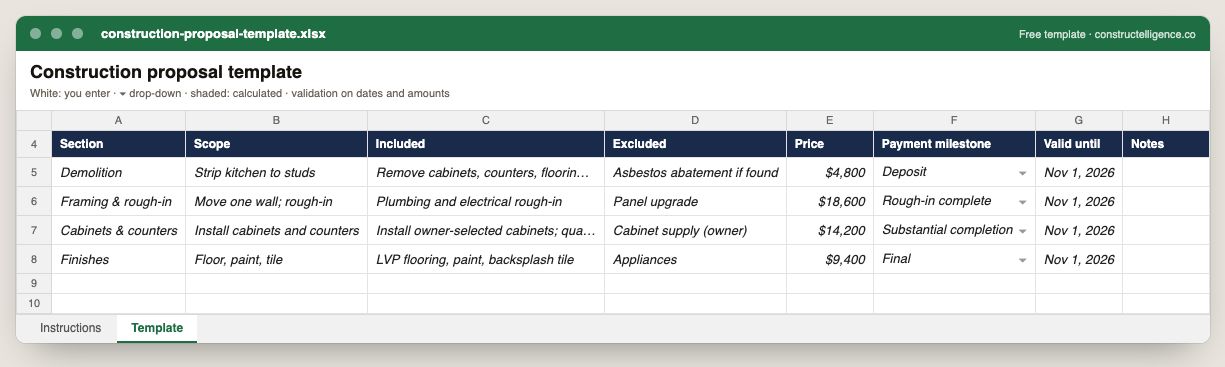
Everything a proposal has to carry for a client to accept it without a phone call: each section of work with its scope, inclusions, exclusions and price, the payment milestone it is billed on, a valid-until date and the proposal total.
8 columns: 7 you fill in and 1 picked from drop-down lists, so every row uses the same values. In the Excel version, 1 column reject entries of the wrong type (a date column only takes dates, an amount column only numbers), the header row stays frozen with filters on it, and the workbook opens on an Instructions sheet that lists every column below.
Every column, and how it is captured
| Column | Type | What goes in it |
|---|---|---|
| Section | Text | A part of the job the client will recognise — demolition, framing, finishes. |
| Scope | Text | What will be done in that section, in plain words. |
| Included | Text | What the price covers, specifically. |
| Excluded | Text | What it does not — permits, finishes by owner, unforeseen conditions. |
| Price | Amount ($) | The price for the section, including your markup. |
| Payment milestone | Drop-down | The stage at which this section is billed. Options: Deposit / Rough-in complete / Substantial completion / Final / Monthly progress. |
| Valid until | Text | Date after which the price has to be re-confirmed (material prices move). |
| Notes | Text | Anything that explains the row; free text. |
See it on real-looking numbers
Constructelligence is a construction intelligence platform: it reads your ERP, project and field systems read-only and does this arithmetic every week, for every job. The demo runs it on a sample eight-job portfolio.
Try the demoJoin the private betaFrequently asked questions
What should be included in a construction proposal?
The scope of work by section, what is included and excluded, the price for each section and the total, a payment schedule, a valid-until date, the assumptions behind the price, your license and insurance details, warranty terms and a place for the client to sign.
What is the difference between a proposal and an estimate?
The estimate is your internal calculation of cost. The proposal is what the client sees: scope, price, exclusions and terms, written to be accepted.
How long should a construction proposal be valid?
Commonly 30 days, shorter when material prices are volatile. State the date on the proposal and re-confirm prices after it.
Should a proposal include a payment schedule?
Yes. Tie payments to milestones the client can see, such as rough-in and substantial completion, and check your state's rules on deposits for home improvement work.
Related guides
More in Templates & forms
- Free construction templates for Excel and Google Sheets
- Construction schedule template: activities, workday finish dates and a free Excel download
- Punch list template: the fields that get items closed, an example and a free Excel download
- Construction change order form: what it must show, a priced example and a free template
- Construction daily report template: what to record every day, an example and a free download
- Construction budget template: budget, committed, actual and forecast by cost code — free Excel
- RFI template: how to write a construction RFI, an example and a free form and log
- Construction timesheet template: hours by job and cost code, overtime and labor cost — free Excel
- Submittal log template: track every submittal from spec to approval — free Excel