



- Concrete is priced and lost by the unit — watch cost per yard and per square foot.
- Record yards ordered and placed on every pour to see waste.
- Charge owned pumps and equipment to jobs at internal rates.
- Review unit cost after each pour, not at the end of the job.
Where concrete contractor jobs make and lose money
- Labor per unit. Forming, placing and finishing hours per square foot or cubic yard.
- Waste. Ordered yards against placed yards.
- Equipment. Pumps, finishing equipment and trucks by the hour.
- Weather and sequence. Cancelled pours and remobilisation.
Key terms: Cost code · Estimate at completion (EAC) · Committed cost
A worked example
A deck pour placed 220 yards from 236 ordered, with 190 crew hours at $78 an hour. The estimate carried $58 of labor per yard:
One pour is small money. The same rate on every remaining pour is the job's margin.
The concrete contractor software stack
Most contractors in this trade run four or five systems. The names below are common examples, not a ranking.
HCSS HeavyBidtakeoff toolsspreadsheetsRakenRhumbixHCSS HeavyJobFoundationSage 300 CREViewpointQuickBooksThe numbers worth tracking weekly
- Unit cost per pour against the estimate
- Yards ordered against yards placed
- Crew hours per unit
- Equipment hours charged to jobs
- Forecast at completion
How to choose concrete contractor software
Five questions to ask any vendor before a trial — each is about whether the software fits how this trade actually makes money.
- Can the estimate's unit costs be compared with actual unit costs per pour?
- Can crews record yards placed and hours from the field the same day?
- Are owned pumps and equipment charged to jobs at internal rates?
- Does it handle cancelled pours and remobilisation as their own cost?
- Can it roll pour results into a forecast for the rest of the job?
Then trial it on a finished job where you already know the answer. The construction tech stack guide covers how the pieces connect.
Where Constructelligence fits
Constructelligence sits on top of the accounting system you already run — Sage 300 CRE and QuickBooks Desktop are connected today, with Viewpoint, Sage Intacct and others in build — and forecasts every job weekly by cost code, so a unit cost creeping above the estimate shows up in the week it starts. It reads read-only, installs on your own infrastructure and replaces none of the tools above. See it in the demo.
Software for other trades
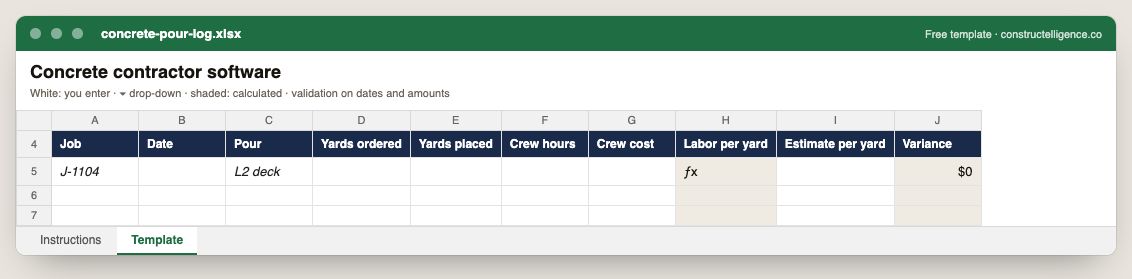
Each pour with yards ordered and placed, crew hours and cost, labor per yard calculated against the estimate and the variance.
10 columns: 8 you fill in and 2 calculated by formula and filled down 200 rows, so nothing is worked out by hand. In the Excel version, 6 columns reject entries of the wrong type (a date column only takes dates, an amount column only numbers), the header row stays frozen with filters on it, and the workbook opens on an Instructions sheet that lists every column below.
Every column, and how it is captured
| Column | Type | What goes in it |
|---|---|---|
| Job | Text | Job number exactly as in your accounting system (e.g. J-1104), so rows join to job cost. |
| Date | Date | Date of the entry. |
| Pour | Text | Free text. |
| Yards ordered | Number | Enter a number. |
| Yards placed | Number | Enter a number. |
| Crew hours | Number | Enter a number. |
| Crew cost | Amount ($) | Enter the amount in dollars. |
| Labor per yard | Calculated | Calculated: [Crew cost] ÷ [Yards placed] |
| Estimate per yard | Amount ($) | Enter the amount in dollars. |
| Variance | Calculated | Calculated: [Labor per yard] − [Estimate per yard] |
See it on real-looking numbers
Constructelligence is a construction intelligence platform: it reads your ERP, project and field systems read-only and does this arithmetic every week, for every job. The demo runs it on a sample eight-job portfolio.
Try the demoJoin the private betaFrequently asked questions
What software do concrete contractors use?
Estimating (HCSS HeavyBid for civil work, takeoff tools or spreadsheets), field reporting for crews and quantities (such as Raken, Rhumbix or HCSS HeavyJob), and construction accounting such as Foundation, Sage 300 CRE, Viewpoint or QuickBooks.
How do concrete contractors track job cost?
By unit: labor hours, material and equipment per cubic yard or square foot placed, compared with the estimate's unit costs after every pour, with waste measured as ordered versus placed yards.
What unit costs matter most for concrete?
Labor hours per square foot or cubic yard for forming, placing and finishing; concrete waste; and pump and equipment cost per pour.
How do you calculate concrete labor cost per yard?
Crew hours for the pour times the loaded crew rate, divided by the cubic yards placed. Compare it with the estimate's labor per yard for the same element.
What is a normal concrete waste allowance?
Estimates commonly carry a few percent for waste and over-ordering; what matters is measuring ordered against placed yards on every pour and correcting the allowance from your own history.
Related guides
More in Software by trade
- Construction software by trade
- General contractor software: what to run, what to track, and where jobs lose money
- Electrical contractor software: what to run, what to track, and where jobs lose money
- Plumbing software: what plumbing contractors run, what to track, and where jobs lose money
- HVAC and mechanical contractor software: what to run, what to track, and where jobs lose money
- Roofing contractor software: what to run, what to track, and where jobs lose money
- Excavation and sitework contractor software: what to run, what to track, and where jobs lose money
- Drywall and interiors contractor software: what to run, what to track, and where jobs lose money
- Home builder software: what to run, what to track, and where jobs lose money
- Deck builder software: project management, pricing and where deck jobs lose money
Free tools for this topic: Construction markup vs margin calculator · Construction labor burden calculator · Contractor overhead recovery and break-even calculator
All software by trade resources →