


 ST
ST- Labor is the electrical contractor's biggest variable; material is quoted, labor units are assumed.
- Measure productivity as actual hours ÷ earned hours, by cost code, weekly.
- Installed quantities from the field are what make earned hours possible.
- Forecast labor hours at completion — hours to date alone hide the overrun.
Where electrical contractor jobs make and lose money
- Labor productivity. Actual hours against earned hours (the estimate's labor units for what is installed). See labor forecasting.
- Material price movement. Copper and gear pricing move between bid and buy; quotes expire.
- Change orders. Small field changes add up; unsigned ones are free work.
- Prefabrication. Shop hours need their own cost codes or prefab savings never show up.
Key terms: Earned hours · Productivity factor · Cost code · Estimate at completion (EAC)
A worked example
Branch wiring budgeted at 2,400 hours. The job is 40% installed and has used 1,150 hours:
Hours to date (1,150 of 2,400) look comfortably inside the budget. The productivity factor says the code will finish 20% over.
The electrical contractor software stack
Most contractors in this trade run four or five systems. The names below are common examples, not a ranking.
eSUBProcoreFieldwireFoundationSage 300 CREViewpointQuickBooks with add-onsThe numbers worth tracking weekly
- Productivity factor (actual ÷ earned hours) by cost code
- Forecast labor hours at completion
- Material committed against estimate
- Unsigned change orders
- Over/under billing
How to choose electrical contractor software
Five questions to ask any vendor before a trial — each is about whether the software fits how this trade actually makes money.
- Does the estimate's labor-unit structure carry into job cost codes after award?
- Can foremen record installed quantities, not just hours, from the field?
- Does payroll handle your locals, prevailing wage and certified reports?
- Can prefab shop hours be tracked and charged to jobs separately?
- Does it forecast labor hours at completion, or only report hours to date?
Then trial it on a finished job where you already know the answer. The construction tech stack guide covers how the pieces connect.
Where Constructelligence fits
Constructelligence sits on top of the accounting system you already run — Sage 300 CRE and QuickBooks Desktop are connected today, with Viewpoint, Sage Intacct and others in build — and forecasts every job weekly by cost code, so a labor overrun on a cost code shows up in the week it starts. It reads read-only, installs on your own infrastructure and replaces none of the tools above. See it in the demo.
Software for other trades
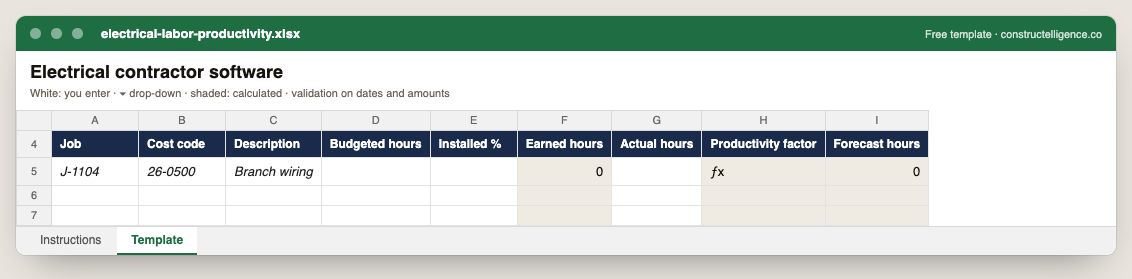
Labor by cost code: budgeted hours and installed percent, with earned hours, the productivity factor and forecast hours calculated.
9 columns: 6 you fill in and 3 calculated by formula and filled down 200 rows, so nothing is worked out by hand. In the Excel version, 3 columns reject entries of the wrong type (a date column only takes dates, an amount column only numbers), the header row stays frozen with filters on it, and the workbook opens on an Instructions sheet that lists every column below.
Every column, and how it is captured
| Column | Type | What goes in it |
|---|---|---|
| Job | Text | Job number exactly as in your accounting system (e.g. J-1104), so rows join to job cost. |
| Cost code | Text | Cost code from your cost code list, matching the estimate and the ERP. |
| Description | Text | What the line is, in words the other party will recognise. |
| Budgeted hours | Number | Hours in the estimate for the line. |
| Installed % | Percent | Enter a percentage, 0–100. |
| Earned hours | Calculated | Calculated: [Budgeted hours] × [Installed %] ÷ 100 |
| Actual hours | Number | Hours charged to the line from timecards. |
| Productivity factor | Calculated | Calculated: [Actual hours] ÷ [Earned hours] |
| Forecast hours | Calculated | Calculated: [Budgeted hours] × [Productivity factor] |
See it on real-looking numbers
Constructelligence is a construction intelligence platform: it reads your ERP, project and field systems read-only and does this arithmetic every week, for every job. The demo runs it on a sample eight-job portfolio.
Try the demoJoin the private betaFrequently asked questions
What software do electrical contractors use?
Typically electrical estimating with labor units (such as Trimble Accubid or McCormick Systems), trade project management (such as eSUB, Procore or Fieldwire), construction accounting with union and certified payroll (such as Foundation, Sage 300 CRE or Viewpoint), and field service software for service work.
How do electrical contractors track labor productivity?
By comparing actual hours with earned hours — the estimate's labor units for the quantities actually installed — by cost code, every week. A productivity factor above 1.0 means the crew is using more hours than planned.
What is the best job costing software for electrical contractors?
One that costs labor, material and subcontract to cost codes that match the estimate, handles union payroll, and can forecast labor hours at completion rather than only reporting hours to date.
What is a labor unit in electrical estimating?
The standard hours an estimate allows to install one unit of an item — a foot of conduit, a device, a fixture — adjusted for conditions. Multiplying installed quantities by labor units gives earned hours.
Can QuickBooks work for an electrical contractor?
For a small shop, yes, with job costing set up by job and cost code. Union payroll, certified payroll, labor productivity tracking and WIP usually push electrical contractors to construction-specific accounting as they grow.
Related guides
More in Software by trade
- Construction software by trade
- General contractor software: what to run, what to track, and where jobs lose money
- Plumbing software: what plumbing contractors run, what to track, and where jobs lose money
- HVAC and mechanical contractor software: what to run, what to track, and where jobs lose money
- Concrete contractor software: what to run, what to track, and where jobs lose money
- Roofing contractor software: what to run, what to track, and where jobs lose money
- Excavation and sitework contractor software: what to run, what to track, and where jobs lose money
- Drywall and interiors contractor software: what to run, what to track, and where jobs lose money
- Home builder software: what to run, what to track, and where jobs lose money
- Deck builder software: project management, pricing and where deck jobs lose money
Free tools for this topic: Construction markup vs margin calculator · Construction labor burden calculator · Contractor overhead recovery and break-even calculator
All software by trade resources →